
A successful custom perfume store design does more than place fragrance bottles on attractive shelves. For chain retailers and perfume brands expanding across Europe, the Americas, Australia, or the Middle East, the store must translate brand identity into a repeatable commercial environment. Layout, lighting, materials, storage, customer flow, and local site conditions all need to work together.
When these decisions are planned as one complete retail system, a brand can open new locations faster, maintain a consistent customer experience, and reduce costly adjustments during installation. This guide explains the main design and manufacturing considerations for a scalable perfume store rollout.
Why Perfume Stores Need a Complete Retail Design System
Fragrance is a sensory product, but the physical store still carries much of the brand message. Customers notice the atmosphere before they test a scent. A premium environment should feel refined without making products difficult to explore, while a high-volume concept needs clear navigation and efficient replenishment.
For a single location, individual display units may be enough. For a chain rollout, however, separate fixtures often create inconsistencies in colour, dimensions, lighting, signage, and storage. A complete design system connects the storefront, wall displays, consultation areas, central islands, cash counter, back storage, and visual merchandising into one coordinated space.
Start With Customer Flow and Product Segmentation
The floor plan should reflect how customers discover and compare fragrances. New releases, hero products, gift sets, and seasonal collections need prominent positions. Supporting ranges should remain easy to browse without competing for attention.
Wall shelving can create a clear product library, while central display tables encourage testing and conversation. Wider circulation routes help busy stores and make the space more comfortable for groups. In compact locations, shallow wall systems and integrated storage preserve selling space. Designers should also consider queueing, consultation, point-of-sale activity, and staff access before finalising fixture dimensions.
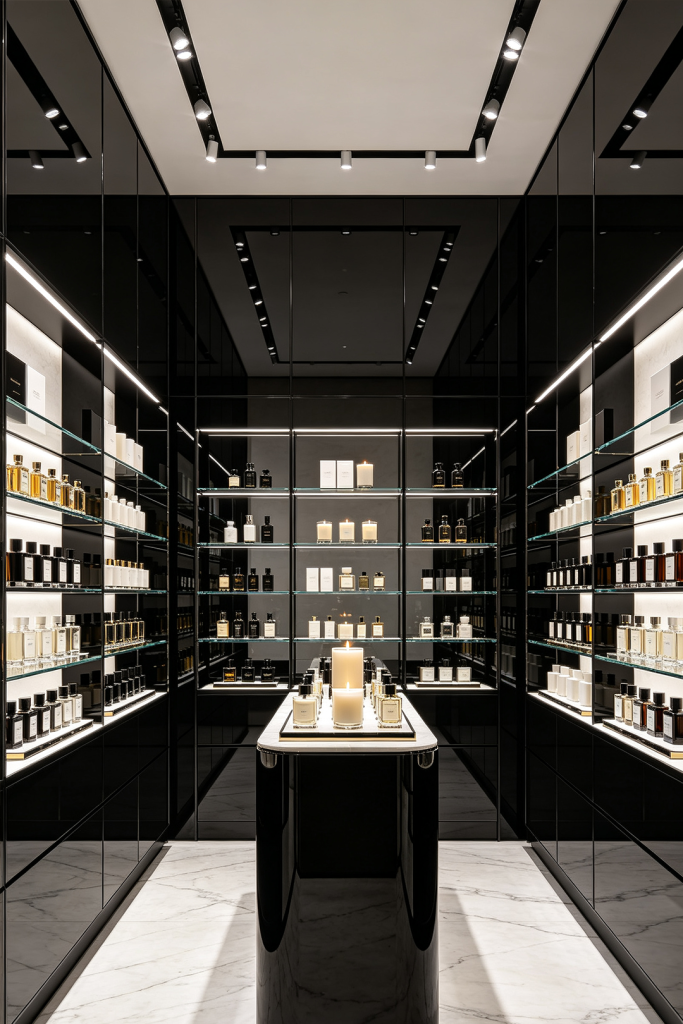
Use Lighting to Present Fragrance Products Clearly
Perfume packaging often combines glass, metallic finishes, detailed labels, and subtle colours. Poor lighting can flatten these materials or produce distracting reflections. Layered lighting is therefore essential.
Ambient ceiling lighting establishes the overall mood. Integrated LED lighting highlights shelves and product faces, while focused accents can draw attention to launches or premium collections. Colour temperature should support the brand palette and remain consistent across stores. Heat management, cable access, driver maintenance, and local electrical requirements should be planned during fixture engineering—not added after production.
Select Materials for Brand Image and Daily Operation
Materials must balance appearance, durability, maintenance, and transport. Painted MDF and laminates provide flexible colour matching. Metal details can add precision and strength, while glass and acrylic create visual lightness. Stone-look surfaces can deliver a premium impression without always requiring the weight of natural stone.
Sampling areas need finishes that tolerate frequent cleaning and contact with fragrance products. Doors, drawers, locks, hinges, and shelf supports should be specified for repeated commercial use. For international projects, modular construction and sensible panel sizes can improve packing efficiency and simplify replacement if a component is damaged.
Build Storage Into the Customer-Facing Fixtures
A beautiful store becomes difficult to operate when stock, testers, packaging, and staff supplies have nowhere to go. Concealed base cabinets, lockable drawers, adjustable shelving, and organised cable zones keep the selling area clean while supporting daily work.
Storage requirements should be discussed early with the retail operations team. A chain store prototype can then standardise the capacity and location of storage across future branches. This helps staff learn the format quickly and keeps the customer experience consistent.
Create a Scalable System for Chain Store Rollouts
Chain expansion requires more than copying a visual concept. Each site may have different dimensions, building regulations, landlord requirements, and service locations. A scalable design uses standard fixture modules together with controlled site-specific adjustments.
The process can begin with site information and brand guidelines, followed by space planning and 3D visualisation. After the concept is approved, technical drawings define dimensions, materials, lighting, graphics, hardware, and installation connections. A prototype or sample review can resolve details before batch production. Numbered packing lists and installation drawings then help local teams identify components on site.
Plan International Production and Delivery Early
Projects serving Europe, the Americas, Australia, and the Middle East need early coordination between design, manufacturing, logistics, and installation. Door sizes, lift access, working hours, packaging restrictions, electrical standards, and delivery schedules can affect the final fixture design.
Export packaging should protect glass, finished panels, lighting components, and metal details during transport. Modular assemblies can reduce shipping volume and make handling easier. Clear labelling, hardware kits, and remote installation support are especially valuable when stores are installed by regional contractors.
What to Include in a Perfume Store Design Brief
- Brand guidelines, logo files, colours, and reference stores
- Site plan, dimensions, photographs, and service locations
- Product categories, SKU quantity, tester requirements, and stock levels
- Preferred customer journey and consultation model
- Required counters, storage, signage, screens, and lighting
- Target opening date, destination, and installation responsibility
A complete brief allows designers and manufacturers to identify risks early and develop a proposal that supports both brand presentation and store operation.
Choose a Partner for the Whole Store, Not Only the Fixtures
The strongest result comes from coordinating design development, fixture engineering, material selection, production, quality inspection, packing, and delivery as one workflow. This reduces gaps between the visual concept and the finished store and gives growing brands a repeatable model for future locations.
If you are planning a new fragrance boutique or a multi-location rollout, contact M2 Display to discuss your store size, target market, brand direction, and opening schedule. Our team can help develop a customised perfume retail environment from initial layout through production and delivery.